Posted on Leave a comment

Nice Goin Slick – You’ve Trained Your Cat To Be An Asshole

How perfectly reasonable humans create tiny, furry extortionists. Your cat wasn’t born knowing that screaming produces breakfast, pawing your face opens doors, and sitting on your keyboard summons immediate attention. Somewhere along the way, you taught the little shitbird that persistence pays.

Your cat has trained you.

While you were congratulating yourself for teaching Fluffy to sit for a treat, Fluffy was conducting a much larger behavioral experiment on you. She meowed. You responded. She meowed louder. You responded faster. She knocked something off the nightstand at 4:17 a.m., and you got up to feed her just to make the bullshit stop.

Congratulations. The experiment worked. You are now fully trained.

Most of us create these habits because we love our cats and occasionally want thirty uninterrupted seconds without screaming, scratching, keyboard stomping, or attempted houseplant murder. Unfortunately, cats are excellent students when the lesson is: ‘Be annoying enough and the human will eventually surrender.’

Cats Do What Works

Cats don’t need an evil master plan. They simply repeat behaviors that produce useful results. In behavior-speak, a consequence that makes a behavior more likely to happen again is reinforcement. In human language: your cat did a thing, got what she wanted, and filed that information away for future use.

If Mika rejects a bowl and I immediately offer something better, she learns that theatrical disgust may upgrade the menu. If Koji plants himself in my path and gets attention, he learns that becoming a furry speed bump works. Food isn’t the only reward—attention, eye contact, an opened door, a toy, or a surrendered chair can all pay the cat. Even ‘Get off the counter, you little shit’ may count as prompt personal service.

The Breakfast Hostage Negotiation

The pre-dawn breakfast shakedown usually starts innocently. The cat wakes you early, and you feed her because you’re tired or she has begun testing gravity with the objects on your dresser. The next morning she starts five minutes earlier. You resist, but eventually get up. She hasn’t learned to stop; she has learned that the required screaming interval is approximately eleven minutes.

Inconsistent rewards make the habit especially stubborn. If yelling succeeds only sometimes (and come to think of it, please don’t yell at your cat), the cat may try harder and longer because the payoff is still possible. Maybe this meow won’t work. Maybe the next one will. Better keep going until the human cracks.

Translation: If you feed the cat after forty minutes of yelling, you have not rewarded silence. You have rewarded forty minutes of yelling.

Different Crime, Same Payment System

Closed doors, occupied keyboards, and kitchen counters all run on the same principle. Scratch the door and it opens. Sit on the keyboard and the human immediately talks, touches, moves, laughs, or offers a distraction. Patrol the counter long enough and eventually somebody leaves chicken within reach.

Koji’s specialty is persistent proximity. Mika prefers targeted inspections when intervention is clearly warranted. Different technique, same corporate objective: redirect all available resources to the cat.

The solution is not louder outrage. Keep counters boring, food put away, and legal perches rewarding. Give attention before the cat commits a felony. Reward the location and behavior you want instead of making misbehavior the fastest route to customer service.

How to Untrain the Tiny Menace Without Becoming One Yourself

The answer is not punishment, intimidation, spray bottles, yelling, or declaring war on an eight-pound animal with the reflexes of a ninja. Punishment can create fear, damage trust, and fail to teach the cat what she should do instead. The more useful approach is to change what pays.

  1. Find the payoff. Is the cat seeking food, attention, access, play, height, warmth, or relief from boredom? You can’t change the arrangement until you know what she is collecting.
  2. Stop paying the behavior you dislike. If it is safe to ignore, be boring and consistent. Do not hold out for twenty minutes and then surrender; that teaches the cat to persist for twenty-one.
  3. Reward an alternative. Feed quiet waiting instead of screaming. Pet paws-on-the-floor instead of a cat climbing your leg. Put a legal bed beside the keyboard and reward the cat for using it.
  4. Manage the environment—and the humans. Use timed feeders, put food away, provide scratching surfaces, vertical territory, and scheduled play. Everyone must follow the same rules; one person secretly feeding the screamer can keep the entire racket alive. Expect a temporary surge in effort when the old payoff disappears. The cat is checking whether the policy has truly changed.

First, Make Sure It Isn’t a Health Problem

A sudden behavior change is not a training issue until medical causes have been considered. New nighttime yowling, increased hunger, unusual clinginess, house-soiling, aggression, restlessness, or dramatic changes in routine can be associated with pain, illness, sensory changes, or age-related problems.

If the behavior is new, intense, or accompanied by changes in appetite, thirst, weight, litter-box use, mobility, or energy, call your veterinarian. Do not attempt to out-stubborn a medical problem. The cat will win, and everybody will feel like an asshole.

You’re Not a Failure. You’re Just Extremely Trainable

Most feline dictatorships are built one surrender at a time. We open the door, refill the bowl, move out of the chair, and pet the cat because she yelled—then wonder why she has become the furry regional manager of Human Compliance.

The good news is that learned behavior can change. The less-good news is that the human part of the arrangement usually has to change first. Mika and Koji aren’t manipulative masterminds; they are observant animals who know which sounds get attention, which positions stop work, and exactly how long to stare before I question whether they have ever been fed.

So if your cat screams for breakfast, commandeers your workspace, negotiates at every closed door, or turns the counter into a crime scene, look in the mirror. There stands the trainer.

Closing thought: Your cat may be an asshole—but there is an uncomfortable possibility that you personally approved the training curriculum.

Ciao,

The snarkiest cat…

The Cat Whisperer Blog
Snarky Cat Boutique

Written for the Cat Whisperer Blog by Annie St. Germain, Editor in Chief, and her Kitty chroniclers Mika and Koji at Snarky Cat Boutique.

Want more kitty snark delivered straight to your inbox like a cat hairball on your pillow? Sign up for my monthly-ish newsletter – The Scratching Post Press, and remember to Subscribe to The Cat Whisperer Blog so you don’t miss a toe bean.

Snarky Cat Boutique — Powered by coffee, creativity, cat hair and cusswords – not necessarily in that order.

Be sure and check out my new Cat Whisperer Blog Podcast channel. Each week I bring selected posts from The Cat Whisperer Blog at SnarkyCatBoutique.com to life in audio. Stay tuned for real-life cat stories, feline humor, cat behavior insights, practical cat care tips, and the everyday adventures of my two quirky rescue cats, Mika and Koji. Every episode is paired with photos that bring the stories to life.

Here’s the link: The Cat Whisperer Blog Podcast

Posted on Leave a comment

Congratulations, You’ve Been Selected – How Cats Choose Their Favorite Human

and what the hell you did to earn it…

People like to believe they choose their cats. This is adorable.

We visit the shelter, meet a litter, answer an online listing, or find a tiny feline squatter screaming beneath the porch. We sign the paperwork, buy the litter box, haul home a carrier, and confidently announce that we have acquired a cat.

Meanwhile, the cat is conducting an extensive background check.

Your lap stability is evaluated. Your punctuality at breakfast is noted. Your willingness to surrender the good chair is observed. Your bathroom habits are monitored with a level of interest normally reserved for federal investigations. Eventually, the cat reaches a decision: you may remain.

But becoming the resident food dispenser is not necessarily the same thing as becoming the favorite human. Cats are far more particular than that. They choose their people according to a mysterious blend of trust, predictability, respect, emotional compatibility, and—let’s be honest—who gives the best body scritches without getting grabby.

Food Gets You an Interview. It Does Not Guarantee the Position.

Yes, cats notice who fills the bowl. They are not fools. Anyone operating a household with feline management understands that meals are tracked to the minute, and an unacceptable delay may be reported through screaming, ankle harassment, strategic countertop occupation, or all three.

Food can certainly create a positive association. But cats often form their strongest bond with the person who makes them feel safest—not simply the person holding the can opener.

That may be the human who speaks softly, moves predictably, lets the cat initiate contact, and understands that a tail flick is not an invitation to continue rubbing the exact same spot. It may be the human who sits quietly enough to become furniture. It may even be the person who insisted, ‘We are absolutely not getting a cat,’ shortly before becoming the cat’s heated mattress and sole emotional-support employee.

Because cats appreciate resistance. It gives them something to conquer.

The Official Feline Hiring Criteria

Every cat has individual preferences, but the successful candidate usually demonstrates several important qualifications:

  • Cats generally appreciate knowing what happens next. Regular meals, familiar routines, and a human who does not behave like a malfunctioning leaf blower help create trust.
  • Respect for boundaries. The person who allows a cat to approach—and accepts when the meeting has concluded—often becomes far more appealing than the person determined to love the cat by force.
  • A compatible energy level. Some cats adore chatter, activity, and participation. Others prefer a calm human who can occupy a room without turning every moment into an interactive workshop.
  • Correct use of hands. Scratching the preferred areas is good. Touching the forbidden belly because it looked fluffy is a performance issue that may remain in your permanent file.
  • Emotional safety. Cats notice tone, movement, tension, and consistency. They may not understand the cause of your bad day, but they are excellent students of the atmosphere around them.

None of this means you must tiptoe through your own house while whispering apologies. It simply means cats pay attention to how we make them feel. They remember who listens when they say ‘enough.’

Koji: Chief Attachment Officer and Personal Security Detail

Koji’s selection process appears to have ended some time ago. He chose me, stamped the paperwork, and eliminated the possibility of appeal.

From the moment I get up in the morning until he reports for his daily nap around ten or eleven, Koji follows me with the dedication of a furry Secret Service agent. He wants proximity. Preferably physical proximity. If I sit down, there is a strong possibility that I have not merely taken a seat; I have opened a docking station.

He rubs against me, settles near me, and keeps track of where I am as though I might attempt to leave the property without submitting the appropriate forms. Around unfamiliar people, he may initially be wary—but then he often plants himself on my lap. Part comfort, part protection, part public declaration of ownership.

Koji’s version of affection is clear: ‘You are my person. I will accompany you everywhere. No, the bathroom is not an exception. Frankly, that is where you seem least supervised.’

Some cats display attachment through constant contact and shadowing. They follow their chosen human between rooms, sleep against them, greet them at the door, or simply make certain there is never more than one cat-length of unauthorized space between them.

It is love. It is also surveillance.

Mika: Love, But With Office Hours

Mika is attached to me too. She simply refuses to turn it into a needy little production.

After breakfast, she is perfectly capable of wandering away to her favorite windowsill or locating a private place to nap. She does not require a full morning escort assignment. Mika’s affection is offered on Mika’s schedule, under Mika’s terms, and subject to cancellation without notice.

That does not make her less bonded. It makes her independent.

Independent cats may show preference in quieter ways. They choose to rest in the same room rather than on your body. They appear beside you when the house is calm. They blink slowly from across the room, sleep with their back toward you, or allow you access to a vulnerable moment without making a spectacle of it.

Mika may not follow me like a small, anxious intern, but she knows exactly where I am. She simply trusts that I can manage unsupervised for several minutes at a time.

That is a significant vote of confidence from a Tortie.

Clingy and Independent Are Both Forms of Trust

Humans tend to recognize affection most easily when it looks like our version of affection: cuddling, enthusiastic greetings, and obvious bids for attention. Cats are less committed to making their emotions convenient for us.

One cat may climb onto your chest and stare directly into your soul. Another may sleep six feet away with one paw pointed in your general direction. Both may feel completely secure and deeply connected.

The better question is not, ‘Why doesn’t my cat love me the same way that other cat does?’ It is, ‘How does this particular cat communicate trust?’

If a cat chooses to relax near you, exposes a vulnerable sleeping position, grooms in your presence, greets you with an upright tail, seeks you out after something unsettling, or simply includes you in the daily routine, you are probably more important than you realize.

Can a Cat Have More Than One Favorite?

Absolutely. Feline household roles are frequently distributed according to specialty.

One human may be the official breakfast department. Another provides the superior lap. Someone else possesses unmatched wand-toy technique. A cat may seek one person when frightened, another when playful, and a third when attempting to obtain a second dinner through administrative confusion.

This is not betrayal. It is efficient management.

A cat’s preferences may also change over time. Trust can deepen as routines develop, health changes can affect sociability, and a formerly distant cat may become remarkably affectionate once the household feels completely safe. Conversely, even the most devoted cat occasionally needs space without this becoming a referendum on the relationship.

How to Improve Your Chances Without Becoming Pathetic

You cannot force a cat to choose you. Attempting to do so usually produces the opposite result, along with an expression suggesting that your application has been moved directly to the shredder.

You can, however, become a more appealing candidate:

  • Let the cat initiate some interactions instead of reaching automatically.
  • Learn the cat’s preferred scratching locations and the places that are none of your damn business.
  • Use play to create positive, low-pressure time together.
  • Keep routines reasonably consistent, especially around meals and bedtime.
  • Notice the small signs of connection instead of demanding a lap cat performance.
  • Stop touching the belly unless you enjoy making preventable mistakes.

Most importantly, allow the relationship to become what it actually is—not what you expected when you brought the cat home.

The Final Selection Notice

Being chosen by a cat is not always dramatic. There may be no ceremonial announcement. No tiny envelope will arrive informing you that your lap has been approved for occupancy.

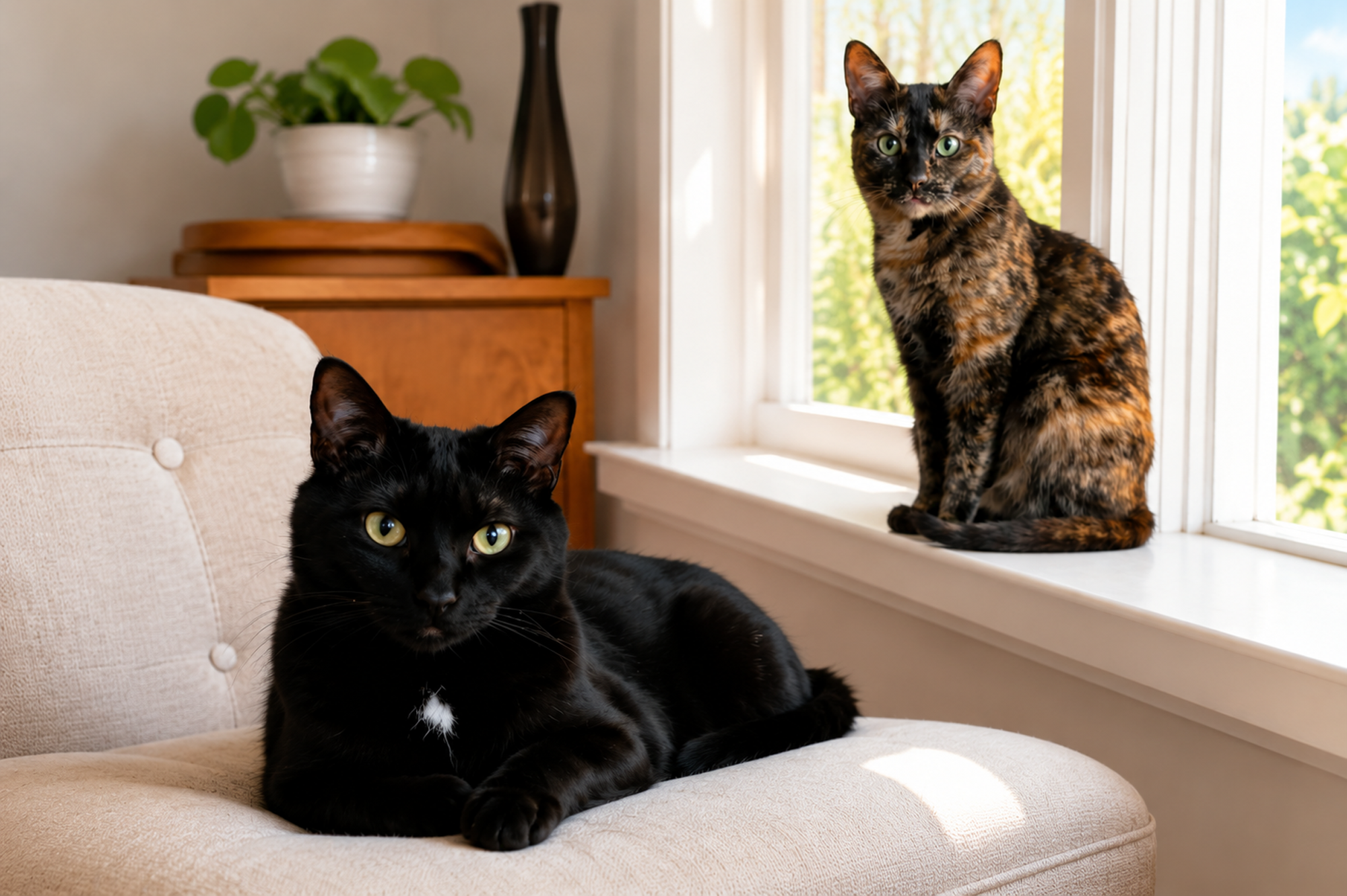
You may simply look up one day and realize there is a black cat following you from room to room like a devoted little bodyguard. Or a tortie stationed on the windowsill, apparently ignoring you while remaining fully aware of every move you make.

One needs closeness. The other needs autonomy. Both have made their decision.

Congratulations. You’ve been selected. The position is unpaid, the hours are terrible, and your supervisor may bite—but the benefits are excellent.

You are trusted. You are familiar. You are home.

Now get up. Someone’s bowl is apparently empty in the middle.

Ciao,

The snarkiest cat…

The Cat Whisperer Blog
Snarky Cat Boutique

Written for the Cat Whisperer Blog by Annie St. Germain, Editor in Chief, and her Kitty chroniclers Mika and Koji at Snarky Cat Boutique.

Want more kitty snark delivered straight to your inbox like a cat hairball on your pillow? Sign up for my monthly-ish newsletter – The Scratching Post Press, and remember to Subscribe to The Cat Whisperer Blog so you don’t miss a toe bean.

Snarky Cat Boutique — Powered by coffee, creativity, cat hair and cusswords.

Be sure and check out my new Cat Whisperer Blog Podcast channel. Each week I bring selected posts from The Cat Whisperer Blog at SnarkyCatBoutique.com to life in audio. Stay tuned for real-life cat stories, feline humor, cat behavior insights, practical cat care tips, and the everyday adventures of my two quirky rescue cats, Mika and Koji. Every episode is paired with photos that bring the stories to life.

Here’s the link: The Cat Whisperer Blog Podcast
 

Posted on Leave a comment

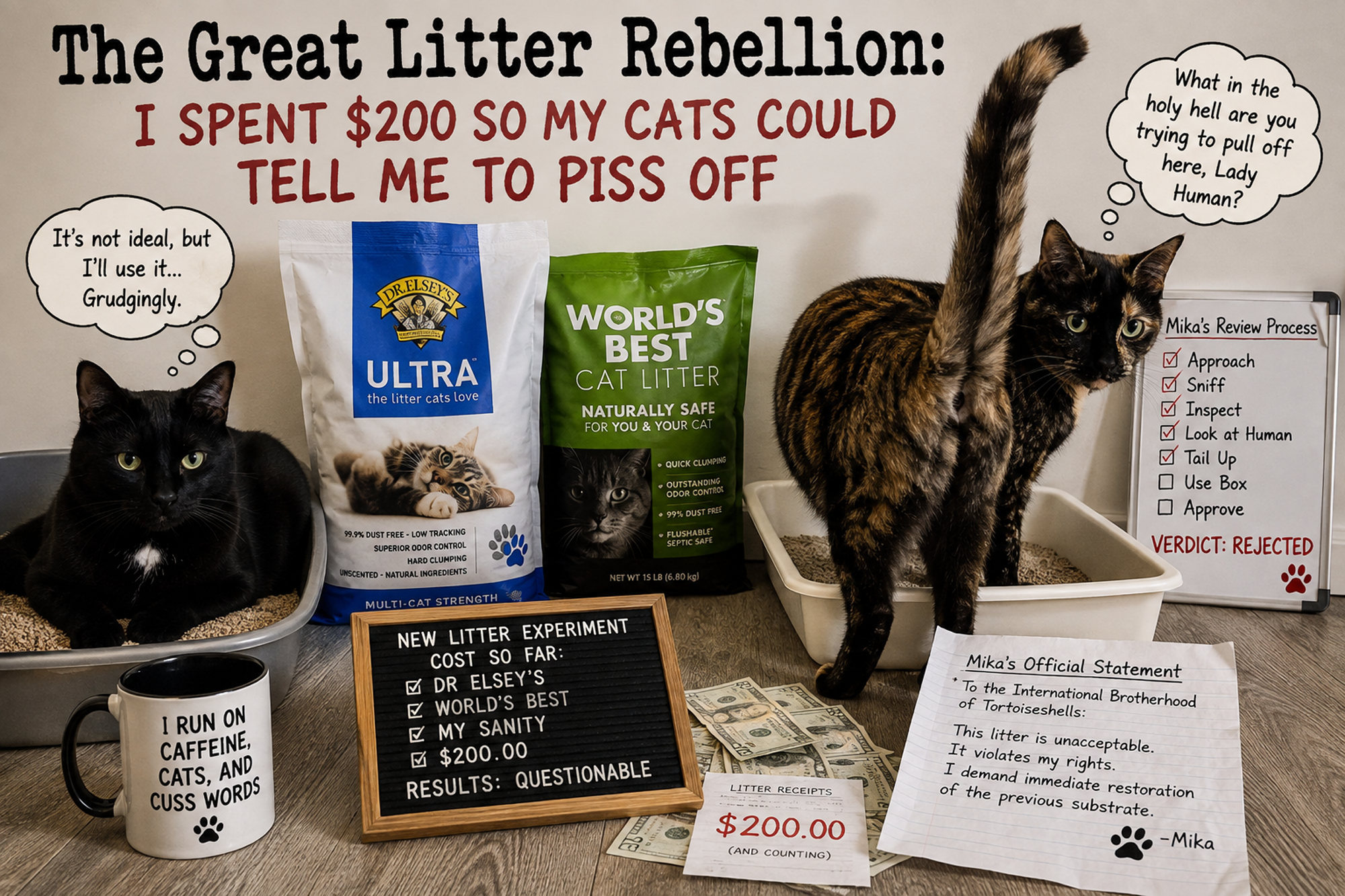
The Great Litter Rebellion: I Spent $200 So My Cats Could Tell Me to Piss Off

A true story of good intentions, expensive cat litter, and two feline quality-control inspectors who were not consulted.

It Seemed Like a Perfectly Reasonable Idea

Every once in a while, I get one of those ideas that sounds sensible, responsible and downright enlightened. This should have been my first warning.

This week’s brilliant idea was to switch Mika and Koji to a more natural, unscented cat litter. Nothing radical. Nothing involving crystals blessed beneath a full moon or artisanal sawdust harvested by woodland nymphs. Just a good-quality litter without all the perfume and unnecessary nonsense.

I figured I would buy the litter, pour it into the boxes, and the cats would use it.

That sentence is adorable in retrospect.

Over the course of the experiment I tried Dr. Elsey’s. I tried World’s Best. I bought litter, hauled litter, poured litter, scooped litter, stared thoughtfully at litter, and somehow managed to spend what felt like a couple hundred dollars conducting a feline bathroom study nobody had asked me to conduct.

Koji was the more diplomatic participant. He investigated the new arrangement and, although clearly not thrilled with management’s decision, used the box a few times during the week.

His review seemed to be roughly: “I object to this, but I am willing to pee under protest.”

Mika took a different approach.

Enter the Tortie Quality-Control Department

Mika is a sniffer. A serious sniffer. If something enters this house, Mika’s nose needs to conduct a full forensic examination before the rest of the cat is willing to form an opinion.

So she would walk up to the litter box. Stop. Look inside. Sniff.

Then she would look at me.

And walk away with her tail in the air.

There was no confusion in that look. No uncertainty. No need for an animal communicator.

It said, very clearly: “What in the holy hell are you trying to pull off here, Lady Human?”

Mika would apparently rather explode than participate in an unauthorized litter change.

And this is one of those moments when living with cats reminds you who actually makes household policy. I can choose the brand. I can read the reviews. I can compare ingredients, dust levels, tracking, odor control and environmental impact. I can even drag a forty-pound bag through the house while muttering obscenities.

But at the end of the day, there is one product review that matters.

Did the cat poop in it?

Unfortunately, the Experts Have Thoughts

This is where I am forced, reluctantly, to admit that there is actual science and behavioral advice surrounding litter changes. Apparently the recommended method is not “dump the new stuff in there and explain that this is what we’re doing now.”

Cats can develop very specific preferences about their litter. Texture matters. Scent matters. Depth matters. The box itself matters. Where the box is located matters. Whether another cat is lurking nearby like a furry bathroom attendant can matter.

Cornell University’s Feline Health Center notes that most cats prefer unscented, finer-textured litter, generally around one to two inches deep. Cornell also specifically warns that a cat may dislike a litter after a sudden brand change and recommends introducing a new litter gradually by adding small amounts of the new product to the old.

VCA Animal Hospitals gives similar advice: unfamiliar litter can be stressful because cats care about its smell, texture and how it feels under their paws. Their recommendation is to slowly mix increasing amounts of the new litter with the familiar litter over several days.

So yes. Gradually. Slowly. Patiently.

Yadda, yadda.

I ain’t got time for that shit.

My personal method remains considerably more direct: Here’s the litter. There’s the box. Please conduct your business accordingly.

As Mika demonstrated, cats do not recognize this management philosophy.

For People With More Patience Than I Apparently Possess

If you’re thinking about changing your cat’s litter and would prefer not to turn your home into a tiny feline labor dispute, the more sensible approach looks something like this:

Don’t go cold turkey if your cat is picky. Start with mostly the familiar litter and add a small amount of the new litter. Increase the new proportion gradually. A sudden change can be enough to make some cats reject the box.

Choose unscented when possible. Many cats prefer unscented litter. What smells “fresh” to us may smell like somebody detonated a perfume counter inside the cat’s bathroom.

Pay attention to texture. Fine-textured litter is commonly preferred, but “commonly” does not mean your cat signed the agreement. Paw feel can be a surprisingly big deal.

Give them a choice. For especially suspicious cats, place two identical boxes side by side with different litters. VCA calls this a “litter box cafeteria.” Whichever box gets the most business is your customer satisfaction survey.

Change one thing at a time. If you’re testing litter, don’t simultaneously move the box, buy a covered box, relocate it beside the washing machine and introduce a new air freshener. You’ll have no idea which particular human decision offended the cat.

Keep the boxes clean. Even a cat who likes the litter may reject a dirty box. Scoop regularly and keep the setup inviting.

In a multi-cat household, provide options. A common veterinary guideline is one litter box per cat, plus one extra, placed in more than one location when possible.

Watch what your cat is telling you. Repeated sniffing, hovering, perching on the edge, refusing to dig, using the box inconsistently or eliminating beside it can all be clues that something about the setup is unacceptable.

Don’t Win the Litter Battle and Lose the War

There is, however, one part of this that isn’t funny.

If your cat starts avoiding the litter box, don’t get into a battle of wills and assume the cat is being spiteful. Cats can avoid boxes because they dislike the litter or box setup, but urinary problems, digestive problems, pain, mobility issues and other medical conditions can also cause changes in litter-box behavior.

If your cat suddenly starts urinating or defecating outside the box, strains, cries, repeatedly enters the box without producing much, or otherwise shows a significant change in bathroom habits, that’s veterinarian territory rather than a household negotiation.

The goal isn’t to prove that the human was right about the fabulous new litter. The goal is to have a healthy cat who reliably uses the box.

Sometimes that means admitting defeat and putting the old litter back.

The cat will not congratulate you for reaching this conclusion.

So, How Did the Great Litter Experiment End?

Pretty much the way you’d expect.

Koji demonstrated that he is capable of compromise. He wasn’t enthusiastic about the new litter, but he gave it a few tries. That’s Koji. Cautious, suspicious, but occasionally willing to entertain the possibility that his human hasn’t completely lost her mind.

Mika filed a formal grievance through the International Felinehood of Tortoiseshells.

Her position was firm.

No.

Not “maybe later.”

Not “I need more time to adjust.”

No.

And frankly, when a tortie plants that flag, you have to decide just how much of your life you’re willing to devote to arguing about granulated material somebody poops in.

Apparently my limit is somewhere around $200.

The Final Verdict

Here’s what I learned from my expensive little experiment.

The best cat litter in the world is not necessarily the litter with the best reviews, the most natural ingredients, the least dust, the cleverest marketing or the environmental credentials that make you feel like a responsible citizen of Earth.

The best litter is the one your cat will actually use.

Humans purchase the litter.

Cats approve the litter.

These are entirely different departments.

And if you forget that distinction, there is always a tortoiseshell standing nearby, ready to sniff your expensive purchase, look you directly in the eye, raise her tail and remind you exactly where you fall in the organizational chart.

May your coffee stay hot, your cat litter stay affordable, and your cats continue believing you’re an excellent employee.

Ciao,

The snarkiest cat…

The Cat Whisperer Blog
Snarky Cat Boutique

Written for the Cat Whisperer Blog by Annie St. Germain, Editor in Chief, and her Kitty chroniclers Mika and Koji at Snarky Cat Boutique.

Want more kitty snark delivered straight to your inbox like a cat hairball on your pillow? Sign up for my monthly-ish newsletter – The Scratching Post Press, and remember to Subscribe to The Cat Whisperer Blog so you don’t miss a toe bean.

Snarky Cat Boutique — Powered by coffee, creativity, cat hair and cusswords.

Be sure and check out my new Cat Whisperer Blog Podcast channel. Each week I bring selected posts from The Cat Whisperer Blog at SnarkyCatBoutique.com to life in audio. Stay tuned for real-life cat stories, feline humor, cat behavior insights, practical cat care tips, and the everyday adventures of my two quirky rescue cats, Mika and Koji. Every episode is paired with photos that bring the stories to life.

Here’s the link: The Cat Whisperer Blog Podcast


Sources & Further Reading

Cornell Feline Health Center – Feline Behavior Problems: House Soiling
https://www.vet.cornell.edu/departments-centers-and-institutes/cornell-feline-health-center/health-information/feline-health-topics/feline-behavior-problems-house-soiling

Cornell Feline Health Center – Choosing and Caring for Your New Cat – https://tinyurl.com/3cxkyzvz

VCA Animal Hospitals – Switching to Green Kitty Litter? Read This First – https://tinyurl.com/4pamnykt

VCA Animal Hospitals – Cat Behavior Problems: House Soiling – https://tinyurl.com/2s36e6m7

Editor’s note: This post describes my own litter-switching adventure with Mika and Koji. The practical guidance above is general information and isn’t a substitute for veterinary care when a cat develops a sudden or persistent change in elimination habits.


Posted on Leave a comment

NEWS FLASH: Cats Still Expect Premium Dining During Economic Collapse

Featuring observations from Mika, Koji, and the increasingly alarmed human.

Walk down the pet food aisle these days (or surf the pet food stores on line) and you may find yourself checking the price tag twice.

Then a third time.
Then wondering whether the bag secretly contains tiny flakes of edible gold.

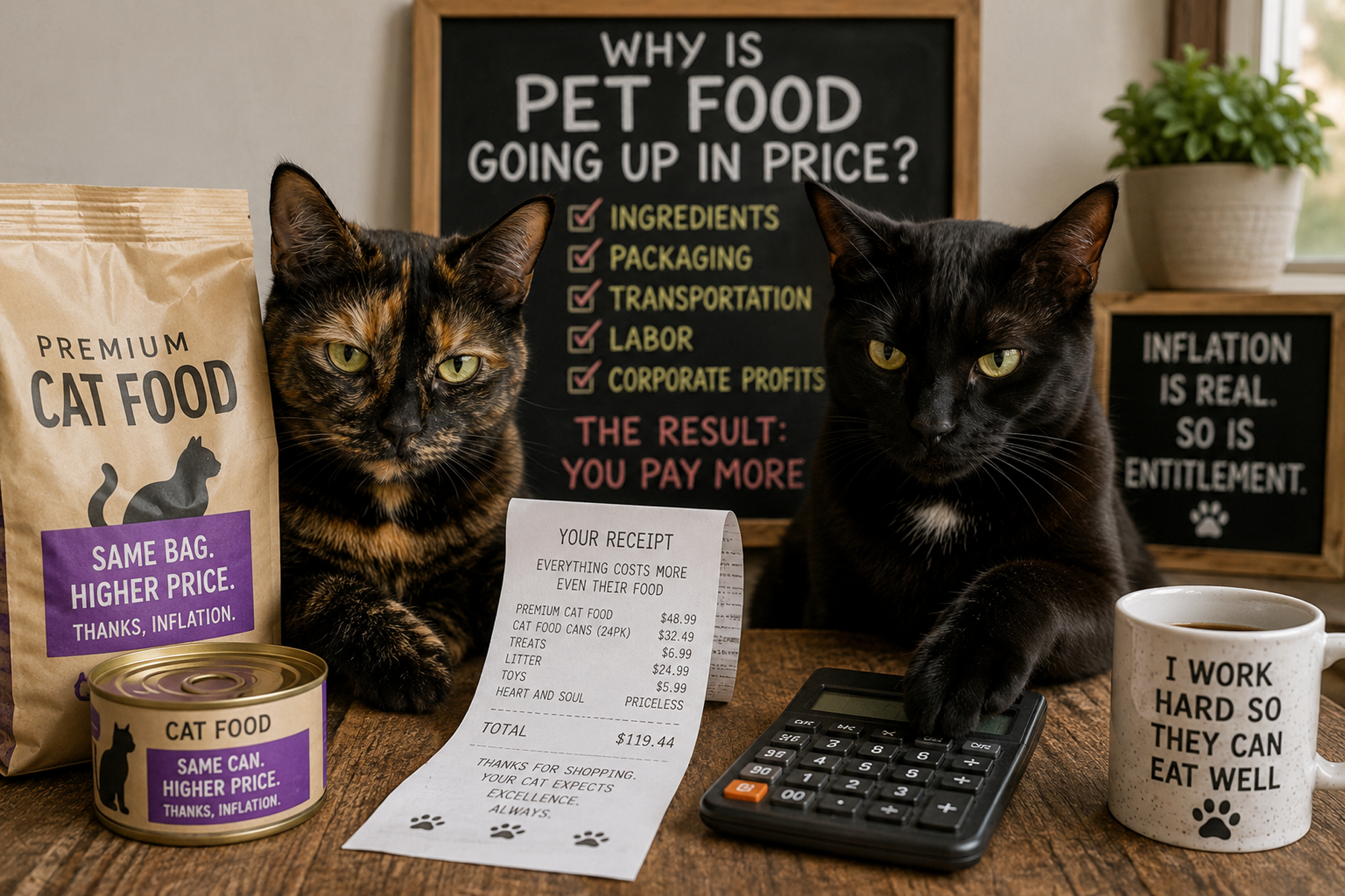
Pet food prices have been climbing steadily for years, and if you’re owned by a cat, you’ve probably noticed. Unfortunately, your feline household managers have not adjusted their expectations to match your budget.

From a cat’s perspective, the explanation is simple:

“The bowl should be full. Your financial concerns are not my department.”

If only economics worked that way.

So what’s really happening?

Several factors have piled on top of one another.

Ingredients cost more than they used to. Chicken, beef, fish, grains, and oils have all become more expensive because of inflation, disease outbreaks, weather problems, and higher farming costs.

Packaging has become more expensive too. Plastic, aluminum cans, cardboard, labels, and even the ink used to print them all cost more than they did just a few years ago.

Transportation isn’t helping either. Fuel prices, shipping expenses, warehouses, and labor all add to the final cost before that bag ever reaches the store shelf.

Then there is the part that leaves many pet owners grumbling into their coffee.

Many of the largest pet food manufacturers continued reporting healthy profits during periods of high inflation. Businesses naturally want to make money, but consumers have noticed that prices rarely come back down once people have become accustomed to paying them.

And just when you think you’ve caught a bargain…

Shrinkflation enters the chat.

The same colorful bag now contains two fewer pounds.
A case of canned food quietly loses a couple of cans.
Sometimes recipes are adjusted with less expensive ingredients while the package proudly announces a “new and improved formula.”

Cats remain unimpressed.

Mika would likely file a formal complaint by chewing on a grocery receipt if dinner arrived late.

Koji would simply stare with that silent expression that says,
“I trusted you to manage the household finances better than this.”

The uncomfortable truth is that many pet foods now cost 30 to 60 percent more than they did several years ago, with some premium brands climbing even higher.

So what can we do?

  • Compare prices by cost per pound instead of sticker price.
  • Use auto-ship discounts when they genuinely save money.
  • Watch for manufacturer coupons.
  • Buy larger bags only if your pets will finish them while the food is still fresh.
  • And resist switching foods simply because one brand happens to be on sale. A cat with an upset stomach can erase those savings in spectacular fashion.

The Bottom Line

Our cats have absolutely no idea what inflation is.
They don’t understand supply chains.
They don’t care about fuel prices.
They have never once worried about quarterly earnings reports.

They simply expect breakfast to appear on schedule.

Perhaps that’s the lesson.

Life is complicated enough without borrowing tomorrow’s worries. Feed the cats, enjoy the quiet moments, laugh at the absurdity of modern life, and remember that the most expensive thing in your house is probably the tiny furry supervisor currently judging your purchasing decisions from atop the refrigerator.

Until next time…

May your coffee stay hot, your cat food stay affordable, and your cats continue believing you’re an excellent employee.

Ciao,

The snarkiest cat…

The Cat Whisperer Blog
Snarky Cat Boutique

Written for the Cat Whisperer Blog by Annie St. Germain, Editor in Chief, and her Kitty chroniclers Mika and Koji at Snarky Cat Boutique.

Want more kitty snark delivered straight to your inbox like a cat hairball on your pillow? Sign up for my monthly-ish newsletter – The Scratching Post Press, and remember to Subscribe to The Cat Whisperer Blog so you don’t miss a toe bean.

Snarky Cat Boutique — Powered by coffee, creativity, cat hair and cusswords.

Be sure and check out my new Cat Whisperer Blog Podcast channel. Each week I bring selected posts from The Cat Whisperer Blog at SnarkyCatBoutique.com to life in audio. Stay tuned for real-life cat stories, feline humor, cat behavior insights, practical cat care tips, and the everyday adventures of my two quirky rescue cats, Mika and Koji. Every episode is paired with photos that bring the stories to life.

Here’s the link: The Cat Whisperer Blog Podcast


Posted on Leave a comment

The Department of Human Supervision

Why Your Cat Isn’t Following You Around… They’re Managing You.

Every cat owner has heard the old saying that dogs have owners and cats have staff. Cute joke. Completely inaccurate. Cats don’t employ us. They supervise us.

Take Koji, for example. From the moment I wake up until roughly ten or eleven in the morning, he’s my shadow. If I wander into the kitchen, he’s there. If I head to the office, he’s right behind me. If I dare close a door, an internal feline audit begins immediately. Personal space, according to Koji, is merely a suggestion.

I used to think he was clingy. Then I realized the truth. He’s not following me because he needs me. He’s following me because somebody has to make sure I don’t accidentally forget why I walked out to the garage, spend twenty minutes doom-scrolling, or fail to pet a perfectly good cat within the federally recommended interval.

His internal job log probably reads something like:

• Human entered kitchen. Possible snack acquisition. Monitoring.
• Human sitting at computer for third straight hour. Initiate Staring At You From Two Feet Away Protocol.
• Human using bathroom. Situation unclear. Stand by outside door until released.

Then there’s Mika.

Breakfast arrives. She eats with quiet dignity, thank you very much. Once she’s comfortably full, she disappears to one of her favorite windowsills or another carefully selected observation post – like up on top of the kitchen cupboards. Unlike Koji, she doesn’t believe in micromanagement. She’s executive management.

Every so often she’ll stroll through the room, inspect operations, silently judge everyone’s performance, and move on without offering a single piece of feedback. Somehow that’s even more intimidating.

The funny thing is that this difference is perfectly normal. Some cats are what behaviorists affectionately call ‘velcro cats.’ They genuinely enjoy being close to their favorite human, following them from room to room simply because they feel safe and connected. Others are independent souls who prefer to check in on their own schedule. Neither personality is better. They’re simply different.

Koji even has another side to his personality. When someone unfamiliar comes through the front door, he immediately shifts into cautious observer mode. He watches from a safe distance until he decides the situation isn’t an immediate threat. Then, more often than not, he’ll quietly hop into my lap while I’m talking with my guest. Whether he’s protecting me or making sure the stranger knows I’ve already been claimed remains open for debate.

Mika? She’d probably glance over from her window, conclude that no one appears to be opening a second can of food, and resume bird surveillance.

The older I get, the more I appreciate these little personalities. In a world that’s constantly demanding our attention, worrying about tomorrow, or arguing about everything imaginable, my two feline supervisors keep life refreshingly simple.

Koji reminds me to slow down and spend time with someone who loves me simply because I’m here. Mika reminds me that sunshine, a comfortable perch, and a little peace are worthy goals all by themselves.

So perhaps our cats aren’t trying to run our lives after all. They’re simply making sure we don’t make a complete mess of them. Judging by the current state of humanity, I’d say they’ve accepted a fairly ambitious assignment.

Until next week…
Give your cat an extra scratch behind the ears, appreciate your tiny household supervisor, and remember: you’re not really in charge. They just let you think you are.

Ciao,

The snarkiest cat…

The Cat Whisperer Blog
Snarky Cat Boutique

Written for the Cat Whisperer Blog by Annie St. Germain, Editor in Chief, and her Kitty chroniclers Mika and Koji at Snarky Cat Boutique.

Want more kitty snark delivered straight to your inbox like a cat hairball on your pillow? Sign up for my monthly-ish newsletter – The Scratching Post Press, and remember to Subscribe to The Cat Whisperer Blog so you don’t miss a toe bean.

Snarky Cat Boutique — Powered by coffee, creativity, cat hair and cusswords.

Be sure and check out my new Cat Whisperer Blog Podcast channel. Each week I bring selected posts from The Cat Whisperer Blog at SnarkyCatBoutique.com to life in audio. Stay tuned for real-life cat stories, feline humor, cat behavior insights, practical cat care tips, and the everyday adventures of my two quirky rescue cats, Mika and Koji. Every episode is paired with photos that bring the stories to life.

Here’s the link: The Cat Whisperer Blog Podcast