Posted on Leave a comment

Cats Are Not Black And White – They Always See The Gray Area

What does the world look like through a cat’s eyes?

Cats are fascinating creatures—stealthy, curious, and supremely adapted for night hunting.But when it comes to color, how do they actually see the world? While humans live in a world filled with vivid hues, cats experience a more muted palette. Let’s explore what colors cats can see, which ones they struggle with, and why their vision is still perfectly tailored to their needs.

What Colors Can Cats See?

Cats are not completely colorblind, but their color perception is quite different from ours. Humans are trichromats, meaning we have three types of cone cells in our eyes that allow us to see a full spectrum of color—red, green, and blue. Cats, on the other hand, are dichromats. This means they have only two types of cone cells, which limits their ability to see the full color range.

Cats can see some shades of:

  • Blue
  • Gray
  • Greenish-yellow

Blue is the color cats see most clearly. Their vision in this part of the spectrum is closest to human perception, making blue toys or objects more visually stimulating to your cat.

Colors Cats Struggle to See

Due to the absence of red-sensitive cone cells, cats cannot see red or pink the way humans do. These colors may appear as:

  • Dark gray
  • Muddy brown
  • Greenish-tan

Similarly, orange and purple can be confusing to cats. Since orange is a mix of red and yellow, and purple is a mix of red and blue, cats perceive them as washed-out or grayish shades.

Cat Vision vs. Human Vision

To better understand how cats see color, imagine looking at the world through a slightly desaturated Instagram filter—where everything is a bit duller, and the red spectrum is nearly nonexistent. Here’s a side-by-side comparison of how vision differs:

Feature Humans Cats
Cone cell types 3 (trichromatic) 2 (dichromatic)
Best color vision Red, green, blue Blue, greenish-yellow
Poor color vision None Red, orange, pink, purple
Night vision Limited Excellent
Motion detection Good Superior

Why Cats Don’t Need Full Color Vision

Although cats can’t appreciate the full rainbow, their vision is specialized for what matters most in their lives: hunting in low light. Their eyes are equipped with more rod cells, which are responsible for detecting motion and working in dim lighting. This is why cats can see so well at dusk and dawn—the prime hunting times for wild felines.

Their limited color range also helps their eyes process shapes and movement faster, which is far more useful for stalking prey than seeing a red rose in its full vibrance.

As a cat owner, how can we use this information?

Understanding your cat’s vision can help you choose toys and accessories that are more engaging. Try these tips:

  • Opt for blue or yellow toys rather than red or pink ones.
  • Use contrast—such as a blue toy on a white floor—to make objects easier for your cat to see.
  • Avoid relying solely on color when training or entertaining your cat—movement, sound, and scent are far more compelling.

Cats may not see the world in Technicolor, but their vision is perfectly suited for their needs. While they miss out on fiery reds and vibrant pinks, they make up for it with incredible low-light vision and keen motion detection. So next time you watch your cat pounce on a toy, remember: it might not be the color they’re reacting to—but the slightest flick of movement in a world they see just a little differently.

Ciao,

Posted on Leave a comment

You Want Me To Do WHAT? Yes You Can Train A Cat

Cats certainly are independent creatures. It seems as though they are resistant to training and indifferent to human commands. Dogs are known for their eagerness to learn and please. Cats carry a reputation for being aloof and stubborn. But is it really impossible to teach a cat new tricks? In reality, I think it’s important that we give cats credit for being able to learn some of the same things dogs can. Teaching cats certainly requires a different approach, a good understanding of their nature, and hefty dose of patience.

How Much Can You Teach a Cat?

  1. Basic Commands
    You might be surprised to know that cats can be taught basic commands like “sit,” “stay,” come when they’re called or what the word NO means. This kind of training is often associated with dogs, but with the right motivation, cats can pick up on these commands as well. Using positive verbal reinforcement, maybe a treat or two, or affection, is key. Unlike dogs, cats don’t respond well to negative reinforcement or punishment. They are more likely to rebel or disengage if they feel coerced. Personally, I think dogs are alike in this as well.
  2. Tricks and Fun Activities
    Cats can also learn more complex tricks like giving a high-five, rolling over, or playing fetch. Some cats are naturally more playful and curious, making them ideal candidates for learning tricks. Clicker training is a popular method where a sound (the clicker) is used to mark the correct behavior, followed by a reward. This method helps cats associate the sound with the action they performed and the treat or other positive reinforcement they receive afterward.
  3. Using the Litter Box
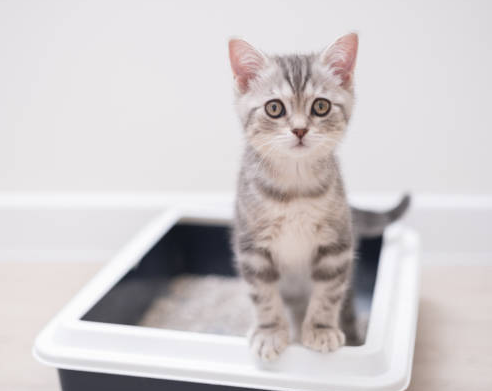
    One of the most common and essential things you can teach a cat is to use a litter box. Most cats have an innate instinct to cover their waste, so this usually doesn’t require extensive training. However, if a cat isn’t using the litter box properly, it can be a sign of stress, illness, or that the litter box or the litter itself isn’t to their liking; location, the cleanliness of the box, type of litter. Understanding these nuances is key to successful training. If you’re really serious about training your cat – even a little bit – you have to be somewhat of a “cat whisperer”.
  4. Behavioral Training
    Teaching a cat not to scratch furniture, jump on counters, or engage in other undesirable behaviors can be more challenging. Cats don’t respond well to punishment, so shouting or spraying them with water is unlikely to work and can damage your relationship. Instead, redirecting the behavior to something more acceptable, like a scratching post or a designated area, and rewarding the cat for using it, tends to be more effective.
  5. Socialization and Tolerance
    Cats can also be trained to be more tolerant of certain activities, like grooming, nail trimming, or even wearing a harness for outdoor walks. Socialization and desensitization techniques are important here. Gradually introducing the cat to these experiences in a calm and positive environment can help them become more accepting over time.

 The Challenges of Training a Cat

While cats are intelligent animals capable of learning, there are several challenges that make training them more difficult than training dogs or other pets.

Their Independence

Cats are naturally independent and often prefer to do things on their own terms (especially if you have a Tortie!). This means that training sessions need to be short, engaging, and timed according to the cat’s mood. Pushing a cat to train when they are not interested will be a frustrating experience for both of you.

Motivation
Unlike dogs, who often seek approval from their owners, cats are usually more self-motivated. Finding the right incentive, whether it’s a favorite treat, toy, or even praise, is crucial. However, once the cat has had enough, they might simply walk away, as if to say – “Ok human, I’ve had enough of this silliness.” – no matter how many treats you offer.

Consistency and Patience
Training a cat requires consistency and patience – this is a given. Progress can be slow, and setbacks are common. However, with regular practice and positive reinforcement, cats can learn a variety of behaviors. The key is to be patient, ready their body language, and not to expect immediate results.

Personality Differences
Every cat is different. Some are more food-driven, while others are more curious or playful. Understanding your cat’s personality will help you tailor your training approach. For example, a highly energetic cat might learn tricks more easily because they are naturally more engaged with their environment. On the other hand, a shy or anxious cat might need more gentle encouragement and time.

Is It Worth the Effort?

I think so! I’ve had both dogs and cats throughout my life. Although training dogs most certainly is a bit easier, training your kitty can be a rewarding experience that strengthens the bond between you. While it definitely requires more patience and a different approach than training dogs, the results are worth it. Not only can you teach your cat fun tricks or useful behaviors, but the mental stimulation is great for them.

I truly believe cats are more trainable than many people assume, but the process requires understanding their unique nature and working with it rather than against it. With the right techniques and plenty of patience, you can teach your cat new behaviors and add to the bonding experience exponentially.

Caio,

Posted on Leave a comment

Poo Patrol – How To Find The Litter That Won’t Hurt Fluffy’s Toe Beans

As any cat owner knows, selecting the right cat litter is not as simple as it might seem. Cats, with their sensitive noses and foot pads, can be very particular about the litter they use. In fact, many cats develop aversions to certain types of litter, leading to issues with litter box use. Continue reading Poo Patrol – How To Find The Litter That Won’t Hurt Fluffy’s Toe Beans

Posted on Leave a comment

Blame It On Mom and Dad – The Role Of Genetics In Your Cat’s Personality

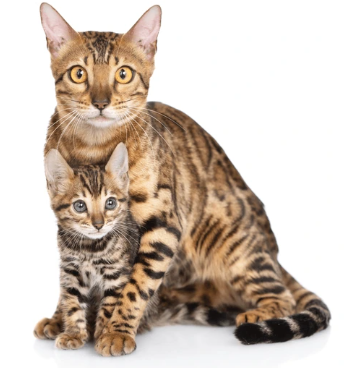
Cats are known for their unique and varied personalities—some are affectionate lap lovers, while others are independent or aloof. While environment and socialization are important factors in shaping a cat’s behavior, genetics play a major role in determining a cat’s temperament. Just as a cat inherits their fur color or eye shape from their parents, many aspects of their personality are written in their DNA.

What Is Cat Temperament?

Temperament refers to a cat’s inherent personality traits, including how they respond to their environment, interact with people and other animals, and cope with new or stressful situations. Key aspects of temperament include:

  • Sociability: Whether a cat enjoys interacting with humans and other animals.
  • Aggression: How likely a cat is to react with aggression when stressed or threatened.
  • Fearfulness: The tendency to be nervous or cautious in new situations.
  • Playfulness: How energetic and curious a cat is, particularly in relation to hunting or playful behaviors.
  • Vocalization: How much kitty “talks” to communicate with their human.

Genetic Basis

Genetics provide the foundation for many aspects of a cat’s personality. Research shows that temperament traits are often inherited, meaning kittens can inherit their sociability, aggression, or playfulness from their parents.

For instance, a study on domestic cats found that kittens from friendly, outgoing mothers were more likely to be social and confident themselves. Interestingly, the father’s temperament can also influence the kittens, even if the kittens are raised by a surrogate mother. This suggests that both parents pass on traits that affect a kitten’s behavior.

Sociability

One of the most sought-after traits in a pet cat is sociability—their ability to interact comfortably with humans and other animals. Genetics play a significant role in determining whether a cat will be a social butterfly or more reserved. Cats with confident, friendly parents are more likely to be outgoing themselves, whereas cats born to more anxious or aloof parents may inherit these traits.

Aggression

Aggression is another trait that can be inherited. Cats with a genetic predisposition toward aggression may be more reactive or territorial. For example, certain breeds, like Siamese, are known for their strong-willed nature and can be more aggressive under stress, while others, like Ragdolls and Maine Coons, are generally more docile.

Although genetics can predispose a cat to be more aggressive, early socialization and proper care can help manage these tendencies. Nonetheless, genetics remain a core factor in how a cat processes stress and reacts to threats.

Fearfulness

Genetics also influence a cat’s tendency toward fearfulness. Cats that are more skittish or easily frightened often inherit this behavior from one or both parents. This trait can be adaptive in the wild, where caution helps protect them from predators. However, in a domestic setting, excessive fearfulness can cause stress and affect their quality of life. Certain breeds, such as Persians, may be more cautious or shy, while others, like Abyssinians, tend to be bolder and more curious.

Playfulness and Energy Levels

Playfulness, often tied to a cat’s prey drive, is another trait shaped by genetics. Cats that come from active, playful parents are more likely to exhibit high energy levels themselves. Breeds like Bengals and Abyssinians are known for their playful and curious nature, while more sedentary breeds, such as British Shorthairs, are typically more reserved.

Vocalization

Ever wonder why some cats are chatterboxes while others are silent observers? Genetics also play a role in how vocal your cat is. Breeds like the Siamese are known for being highly vocal, using their voices to communicate with their owners. This trait has been passed down through selective breeding, making certain cats more talkative by nature.

Breed-Specific Temperaments

Certain cat breeds are known for specific temperament traits, which have been selectively bred over generations. While individual personalities will always vary, breed can offer some insight into what to expect from your cat’s behavior. For example:

  • Siamese: Social, vocal, and active.
  • Maine Coon: Friendly, laid-back, and gentle.
  • Persian: Calm, quiet, and affectionate.
  • Bengal: Energetic, playful, and adventurous.
  • Ragdoll: Affectionate, docile, and relaxed.

These breed-specific traits highlight how genetics shape a cat’s personality, but it’s important to remember that even within breeds, individual cats can vary widely in temperament.

How Environment Interacts with Genetics

While genetics definitely plays a good part in a cat’s temperament, early life experiences and environment play a key role in shaping how these traits manifest. The critical period for a kittens socialization period occurs between two to seven weeks of age. During this time, positive experiences with people, other animals, and new environments can help a kitten grow into a confident, well-adjusted adult.

For example, a kitten with a genetic predisposition toward fearfulness can become more confident with proper handling and socialization. Likewise, a naturally aggressive kitten might learn to be more tolerant with early, positive interactions.

However, genetics cannot be entirely overridden by a kittens early treatment and experiences. A genetically shy or fearful cat may never become as outgoing as one born with a sociable temperament, even with the best socialization.

To Summarize

That said, genetics play a significant role in shaping a cat’s temperament, influencing traits like sociability, aggression, fearfulness, playfulness, and vocalization. While environment and early socialization are important factors in shaping a cat’s behavior, many aspects of a cat’s personality are inherited from their parents.

Understanding the genetic influence on your cat’s temperament can help you better care for them, providing the right environment and support for their unique personality. Whether your cat is a playful ball of energy or a quiet, independent observer, their genes are the foundation of the temperament you see every day.

Embrace your kitty’s uniqueness!

Ciao,

Posted on Leave a comment

Why Won’t My Cat Eat This Food?

Alright, fellow cat owners, gather around. We need to talk. If you’re anything like me, you’ve probably found yourself staring at your cat, spoon in hand, and thinking, What the actual F! “Why won’t you just eat this food?! It cost me more than my last meal at that fancy restaurant I went to!” And then, as you gently slide the plate toward their royal highness, they look at you like you’ve just served them a plate of mushy peas covered in dirt. Or worse, they might just turn their back on you entirely. Not even a glance. So, what gives?

Let me paint you a not-so-pretty little picture. You’ve spent hundreds—yes, hundreds—on every flavor, texture, brand, and shape of cat food under the sun. Organic. Grain-free. Gluten-free. A blend of wild-caught salmon and locally sourced quinoa, (is that really a thing?) but your little dahlink is having NONE of it. AHHHHHHHH!!! The nerve.

So what the H is going on? Read on for some freaky feline reasoning…

  1. Because She’s a Cat. Purrrr and simple.

Let’s get this out of the way first: your cat is a creature of chaos and mystery. He/She will not be reasoned with. He/She will not be dictated to. They will, however, stare at you in disgust as you try to offer them anything resembling a meal that doesn’t meet their ridiculously high standards. Cats are finicky by nature, and they can be super picky about food. Just because you spent $50 on a fancy can of pâté doesn’t mean they will deign to even smell it. They’re not going to eat it because you’ve spent money on it. If only humans could be that easy to please.

  1. Texture: The Hidden Dealbreaker

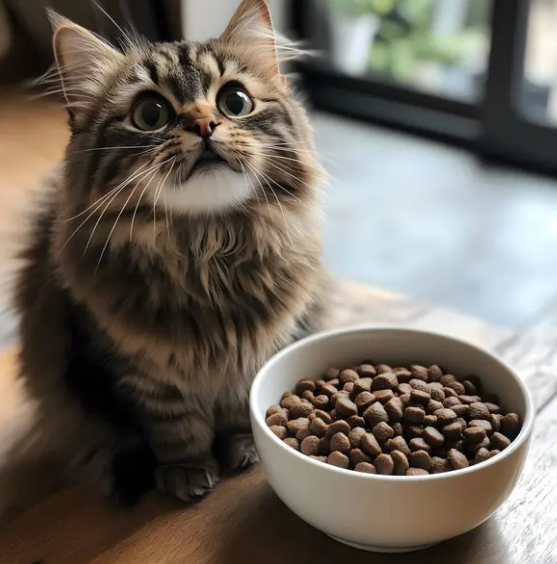
You thought you were so clever, picking up that gourmet pâté or that bone broth soaked kibble. The label says it’s for “sophisticated taste buds or the fussiest of kitties”. Unh huh. Sure. Sounds great. But your cat? They just look at that smooth, wet mess like it’s the worst thing they’ve ever seen. No way are they going to eat that mushy food. You’d think you were trying to feed them a bowl of oranges with garlic (furballs don’t like that stuff). They need crunch. They need that particular texture that says, “I’m a hunter. I’m a warrior. I need something to take a few cautious bites of before I leave my food behind to wither away in the bowl.”

But you, in your infinite wisdom, decide to try soft, moist food again, thinking, “Maybe this time?” Spoiler alert: Guess again. Cats don’t just eat. They’re connoisseurs, and that texture just isn’t right. Have fun with that $50 4 lb. bag of kibble that will never see the light of day.

  1. The “I’ll Only Eat It If It’s the Most Expensive Option” Syndrome

Ah, the golden rule of the feline kingdom: If it’s not expensive, it’s not worthy. Somewhere along the line, your cat has decided that only the finest, most outrageously priced food will do. Enter the $40 bag of freeze-dried raw meat chunks—organic, pasture-raised, and probably blessed by a high priestess. You offer it to them, and they just look at you with disdain, as if to say “How dare you serve me this peasant food when I clearly deserve more?”

But then, bam! The $100+ price tag isn’t just a price tag. It’s a status symbol. You’ve hit the jackpot. Only now, your cat(s) thinks they’re royalty, and you’ll just have to keep spending more and more on exotic food until they decide they’re tired of that too. You’ve created little monsters. Enjoy that $200 worth of canned tuna she’s currently ignoring. Your cat’s food game is an endless loop of escalating luxury and disappointment. And you’re spending a fortune on gas too – driving to the local animal shelter every other day to donate all the stuff your precious little fur ball freaks won’t touch.

  1. The “If It’s Not My Brand, I’ll Starve” Effect

I’ve spent days going through different brands, carefully curating the best ingredients, reading all the reviews like an obsessed scholar. Maybe this will work, you think, maybe this is the one! Nope. Doesn’t matter how gourmet it is or how much research you did. Your cat has one brand that they swear by—and that’s it. The rest? Not in “MEEOW” house.

Do they have any logical reasoning for this? Absolutely not. If only cats possessed the science of reasoning. If it’s not the exact flavor from the exact brand they’ve been eating since they came to live with you, they’ll  give you that look like you’ve just served them a plate of gravel. Meanwhile, you’re sitting there with a mountain of unused cans from that other brand you tried, thinking, I spent how much on these?!

  1. Because She’s Part of a Secret Feline Society

Let’s be real: your cat’s not hungry. He/She is just playing mind games with you. Cats, as you know, are experts in manipulation. They know you’ll try to win them over with the next best thing, and they’ll milk it for all it’s worth. “Ooh, mom’s getting frustrated! Better just pretend to nibble on this for a bit… then refuse to eat it once she’s left the room.”

You, the loving pet owner, are now part of a cruel game of cat-and-mouse, where you’ve spent hundreds of dollars trying to find a food she’ll actually eat. Spoiler alert: she’ll never tell you what she truly wants. It’s like she’s a member of some elite feline society, and only the most dedicated and persistent Cat Whisperers will ever know the true way to please her. But don’t worry, that membership doesn’t come cheap.

  1. The “I’ll Eat It If You Don’t Want Me To” Phase

And just when you think you’ve cracked the code, that’s when the plot thickens. Your cat suddenly decides she’ll only eat the food she’s been turning down for weeks—when you’re not looking. You find a half-eaten dish of $50 raw food tossed aside and wonder, Did they actually eat that? Or are they just toying with me?

The worst part? You can never be sure. One minute, one of them is pawing at the bowl, the next, they’re glaring at you like you’ve committed an unforgivable sin by not providing the preferred brand of chicken. GADS!

So, What’s the Solution?

Well, there is no solution. Cats are enigmas wrapped in fur, and food is just one of their many ways of asserting dominance. You’ll keep buying fancy food, keep trying to cater to their whims, and keep being disappointed. But honestly, isn’t that the true definition of being a cat owner? Let’s all just accept that we’re a bunch of suck-holes. Our bank balance is as low as it’s ever been, and the loveable little freaks will never be satisfied.

But hey, if you figure it out, let me know. I’ll be sitting here with my 20 unopened cans of gourmet food, wondering why my cat is choosing to eat the cardboard box instead.

Ciao,