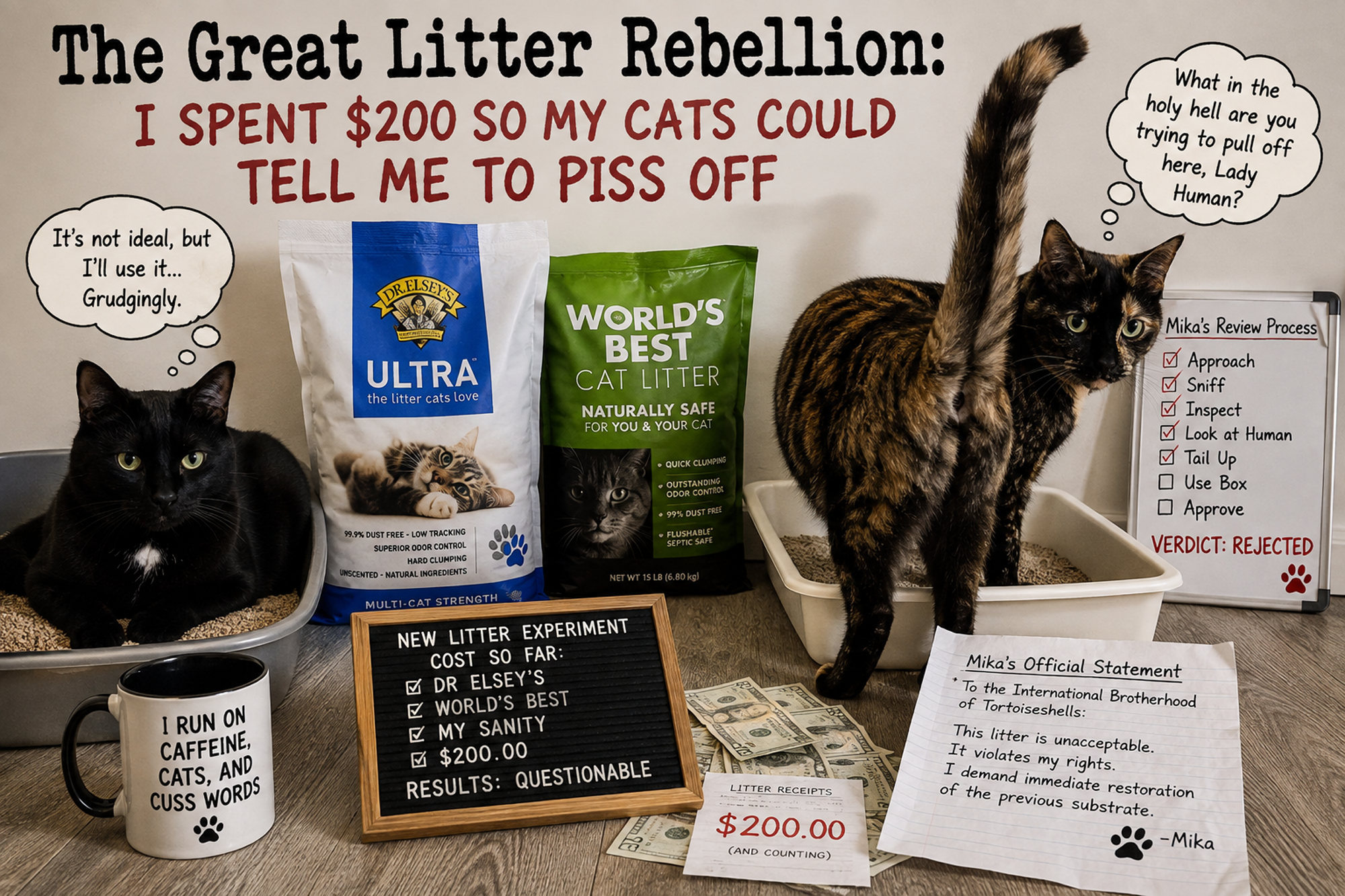
A true story of good intentions, expensive cat litter, and two feline quality-control inspectors who were not consulted.
It Seemed Like a Perfectly Reasonable Idea
Every once in a while, I get one of those ideas that sounds sensible, responsible and downright enlightened. This should have been my first warning.
This week’s brilliant idea was to switch Mika and Koji to a more natural, unscented cat litter. Nothing radical. Nothing involving crystals blessed beneath a full moon or artisanal sawdust harvested by woodland nymphs. Just a good-quality litter without all the perfume and unnecessary nonsense.
I figured I would buy the litter, pour it into the boxes, and the cats would use it.
That sentence is adorable in retrospect.
Over the course of the experiment I tried Dr. Elsey’s. I tried World’s Best. I bought litter, hauled litter, poured litter, scooped litter, stared thoughtfully at litter, and somehow managed to spend what felt like a couple hundred dollars conducting a feline bathroom study nobody had asked me to conduct.
Koji was the more diplomatic participant. He investigated the new arrangement and, although clearly not thrilled with management’s decision, used the box a few times during the week.
His review seemed to be roughly: “I object to this, but I am willing to pee under protest.”
Mika took a different approach.
Enter the Tortie Quality-Control Department
Mika is a sniffer. A serious sniffer. If something enters this house, Mika’s nose needs to conduct a full forensic examination before the rest of the cat is willing to form an opinion.
So she would walk up to the litter box. Stop. Look inside. Sniff.
Then she would look at me.
And walk away with her tail in the air.
There was no confusion in that look. No uncertainty. No need for an animal communicator.
It said, very clearly: “What in the holy hell are you trying to pull off here, Lady Human?”
Mika would apparently rather explode than participate in an unauthorized litter change.
And this is one of those moments when living with cats reminds you who actually makes household policy. I can choose the brand. I can read the reviews. I can compare ingredients, dust levels, tracking, odor control and environmental impact. I can even drag a forty-pound bag through the house while muttering obscenities.
But at the end of the day, there is one product review that matters.
Did the cat poop in it?
Unfortunately, the Experts Have Thoughts
This is where I am forced, reluctantly, to admit that there is actual science and behavioral advice surrounding litter changes. Apparently the recommended method is not “dump the new stuff in there and explain that this is what we’re doing now.”
Cats can develop very specific preferences about their litter. Texture matters. Scent matters. Depth matters. The box itself matters. Where the box is located matters. Whether another cat is lurking nearby like a furry bathroom attendant can matter.
Cornell University’s Feline Health Center notes that most cats prefer unscented, finer-textured litter, generally around one to two inches deep. Cornell also specifically warns that a cat may dislike a litter after a sudden brand change and recommends introducing a new litter gradually by adding small amounts of the new product to the old.
VCA Animal Hospitals gives similar advice: unfamiliar litter can be stressful because cats care about its smell, texture and how it feels under their paws. Their recommendation is to slowly mix increasing amounts of the new litter with the familiar litter over several days.
So yes. Gradually. Slowly. Patiently.
Yadda, yadda.
I ain’t got time for that shit.
My personal method remains considerably more direct: Here’s the litter. There’s the box. Please conduct your business accordingly.
As Mika demonstrated, cats do not recognize this management philosophy.
For People With More Patience Than I Apparently Possess
If you’re thinking about changing your cat’s litter and would prefer not to turn your home into a tiny feline labor dispute, the more sensible approach looks something like this:
Don’t go cold turkey if your cat is picky. Start with mostly the familiar litter and add a small amount of the new litter. Increase the new proportion gradually. A sudden change can be enough to make some cats reject the box.
Choose unscented when possible. Many cats prefer unscented litter. What smells “fresh” to us may smell like somebody detonated a perfume counter inside the cat’s bathroom.
Pay attention to texture. Fine-textured litter is commonly preferred, but “commonly” does not mean your cat signed the agreement. Paw feel can be a surprisingly big deal.
Give them a choice. For especially suspicious cats, place two identical boxes side by side with different litters. VCA calls this a “litter box cafeteria.” Whichever box gets the most business is your customer satisfaction survey.
Change one thing at a time. If you’re testing litter, don’t simultaneously move the box, buy a covered box, relocate it beside the washing machine and introduce a new air freshener. You’ll have no idea which particular human decision offended the cat.
Keep the boxes clean. Even a cat who likes the litter may reject a dirty box. Scoop regularly and keep the setup inviting.
In a multi-cat household, provide options. A common veterinary guideline is one litter box per cat, plus one extra, placed in more than one location when possible.
Watch what your cat is telling you. Repeated sniffing, hovering, perching on the edge, refusing to dig, using the box inconsistently or eliminating beside it can all be clues that something about the setup is unacceptable.
Don’t Win the Litter Battle and Lose the War
There is, however, one part of this that isn’t funny.
If your cat starts avoiding the litter box, don’t get into a battle of wills and assume the cat is being spiteful. Cats can avoid boxes because they dislike the litter or box setup, but urinary problems, digestive problems, pain, mobility issues and other medical conditions can also cause changes in litter-box behavior.
If your cat suddenly starts urinating or defecating outside the box, strains, cries, repeatedly enters the box without producing much, or otherwise shows a significant change in bathroom habits, that’s veterinarian territory rather than a household negotiation.
The goal isn’t to prove that the human was right about the fabulous new litter. The goal is to have a healthy cat who reliably uses the box.
Sometimes that means admitting defeat and putting the old litter back.
The cat will not congratulate you for reaching this conclusion.
So, How Did the Great Litter Experiment End?
Pretty much the way you’d expect.
Koji demonstrated that he is capable of compromise. He wasn’t enthusiastic about the new litter, but he gave it a few tries. That’s Koji. Cautious, suspicious, but occasionally willing to entertain the possibility that his human hasn’t completely lost her mind.
Mika filed a formal grievance through the International Felinehood of Tortoiseshells.
Her position was firm.
No.
Not “maybe later.”
Not “I need more time to adjust.”
No.
And frankly, when a tortie plants that flag, you have to decide just how much of your life you’re willing to devote to arguing about granulated material somebody poops in.
Apparently my limit is somewhere around $200.
The Final Verdict
Here’s what I learned from my expensive little experiment.
The best cat litter in the world is not necessarily the litter with the best reviews, the most natural ingredients, the least dust, the cleverest marketing or the environmental credentials that make you feel like a responsible citizen of Earth.
The best litter is the one your cat will actually use.
Humans purchase the litter.
Cats approve the litter.
These are entirely different departments.
And if you forget that distinction, there is always a tortoiseshell standing nearby, ready to sniff your expensive purchase, look you directly in the eye, raise her tail and remind you exactly where you fall in the organizational chart.
May your coffee stay hot, your cat litter stay affordable, and your cats continue believing you’re an excellent employee.
Ciao,

The snarkiest cat…
The Cat Whisperer Blog
Snarky Cat Boutique
Written for the Cat Whisperer Blog by Annie St. Germain, Editor in Chief, and her Kitty chroniclers Mika and Koji at Snarky Cat Boutique.
Want more kitty snark delivered straight to your inbox like a cat hairball on your pillow? Sign up for my monthly-ish newsletter – The Scratching Post Press, and remember to Subscribe to The Cat Whisperer Blog so you don’t miss a toe bean.
Snarky Cat Boutique — Powered by coffee, creativity, cat hair and cusswords.

Be sure and check out my new Cat Whisperer Blog Podcast channel. Each week I bring selected posts from The Cat Whisperer Blog at SnarkyCatBoutique.com to life in audio. Stay tuned for real-life cat stories, feline humor, cat behavior insights, practical cat care tips, and the everyday adventures of my two quirky rescue cats, Mika and Koji. Every episode is paired with photos that bring the stories to life.
Here’s the link: The Cat Whisperer Blog Podcast

Sources & Further Reading
Cornell Feline Health Center – Feline Behavior Problems: House Soiling
https://www.vet.cornell.edu/departments-centers-and-institutes/cornell-feline-health-center/health-information/feline-health-topics/feline-behavior-problems-house-soiling
Cornell Feline Health Center – Choosing and Caring for Your New Cat – https://tinyurl.com/3cxkyzvz
VCA Animal Hospitals – Switching to Green Kitty Litter? Read This First – https://tinyurl.com/4pamnykt
VCA Animal Hospitals – Cat Behavior Problems: House Soiling – https://tinyurl.com/2s36e6m7
Editor’s note: This post describes my own litter-switching adventure with Mika and Koji. The practical guidance above is general information and isn’t a substitute for veterinary care when a cat develops a sudden or persistent change in elimination habits.
